Table of contents
Somewhere in your organisation, right now, there is a pump.
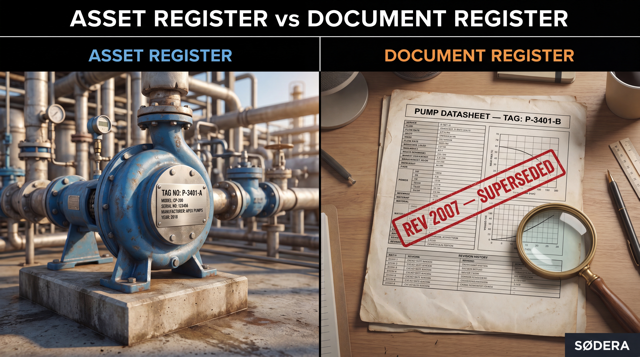
It has a tag number in your asset register. It has a P&ID reference. It has a maintenance history, an inspection schedule, and a criticality rating. By every measure your CMMS can produce, it exists and it is managed.
The problem is that the document register holds a different story. The P&ID that references this pump was revised three years ago. The revision changed the instrument configuration on the outlet side. The as-built drawing was issued. The document register was updated. But the asset register was not. The tag in the CMMS still points to the old configuration. The maintenance procedure was written against the old drawing. The last inspection was scoped against data that has not been true for three years.
Nobody lied. Nobody was careless. The gap opened quietly, the way these gaps always do.
How the Gap Opens
The asset register and the document register are maintained by different people, in different systems, for different purposes. The asset register belongs to maintenance and operations. The document register belongs to engineering and document control. In most organisations, there is no formal process that connects a document revision to an asset record update. Each system is internally consistent. Neither is aware of the other.
When a modification is made in the field, the engineering team issues a revised drawing. Document control logs the new revision. Operations eventually receives the updated drawing. But unless there is an explicit step in the change process that requires someone to update the corresponding asset record, the CMMS is never touched. The tag lives on in its original form. The gap grows by one more item.
Multiply that by hundreds of modifications over a decade and you have an asset register that describes an installation that no longer fully exists, and a document register full of drawings that the asset register has never caught up with.
Why This Matters More Now
For most of the last twenty years, this gap was a background irritant rather than a crisis. Experienced maintenance engineers knew the drawings were not always right. They knew which assets had been modified. They carried that knowledge in their heads and they compensated for the mismatch every day without naming it as a problem. It was just how things worked.
Three things have changed.
The first is workforce turnover. The people who carried that compensating knowledge are retiring. The engineers who replace them do not have twenty years of site memory. They will work from the systems. If the systems disagree, the wrong system will win some of the time.
The second is digital ambition. Organisations that are investing in digital twins, predictive maintenance, and asset performance management are building those systems on top of the asset register and the document register. If those two sources of truth disagree, the digital layer inherits the contradiction. A digital twin that runs on mismatched data does not give you better decisions. It gives you faster wrong decisions.
The third is regulatory pressure. The requirements around safety case documentation, inspection traceability, and asset integrity assurance are tightening. Auditors are no longer satisfied with paper trails that roughly correspond to physical reality. They want the documentation to match what is installed, and they want evidence that the match is maintained over time.
The gap between your asset register and your document register is not a documentation problem. It is a governance problem. It exists because no one owns the boundary between the two systems, and no process requires them to stay aligned.
What the Disagreement Actually Costs
The costs are not usually visible as a single line item. They accumulate in decisions made on incomplete information and in work that has to be redone when the incompleteness surfaces.
A maintenance technician raises a work order against an asset. The work order references the procedure from the CMMS. The procedure describes equipment that was replaced two years ago. The technician arrives on site, looks at what is actually installed, and has to stop. Someone has to find the right documentation. The job is delayed. The cost is absorbed into the day without being attributed to the underlying cause.
An inspection scope is built from the asset register. The scope misses three items that were added during a modification because the modification was never reflected in the register. The inspection is completed. The items are not inspected. The gap is not discovered until the next audit cycle, which finds three uninspected assets in a scope that was supposed to be comprehensive.
A procurement request is raised for a spare part. The part number comes from the asset record. The asset record references the original equipment specification. The equipment was replaced with a different model three years ago. The wrong part arrives. The right part has to be sourced urgently. The downtime extends.
None of these events appear in any report as a consequence of misaligned registers. They appear as delays, procurement errors, and inspection findings. The root cause is invisible.
Which Register Is Lying
Neither of them is lying in the sense of containing deliberate falsehood. Both are telling the truth about the information they were last given. The question is which one has been kept more current, and the answer varies by organisation.
In organisations where engineering drives the programme, the document register is usually more accurate. Drawings are revised, issued, and logged. The asset register trails behind because maintenance systems are updated less frequently and less rigorously.
In organisations where operations drives the programme, the asset register is sometimes more accurate. The maintenance team knows what is installed because they maintain it. The drawing register has not been touched since commissioning.
In most organisations, both contain errors that the other does not, because they have been maintained independently for years and have drifted in different directions.
The answer to which one is lying is: check both against the physical installation and you will find out.
A Short Comparison
| When registers disagree | When they are aligned |
|---|---|
| Work orders raised against ambiguous tags | Work orders trace cleanly to current documentation |
| Inspection scopes miss modifications | Inspection scopes built against verified as-builts |
| Procurement orders parts for superseded equipment | Procurement orders match installed configuration |
| Digital twin underperforms or stalls | Digital twin runs on a trusted information layer |
| Tribal knowledge fills the gap | The information layer is the source of truth |
| Acquisitions take three years to integrate | Acquisitions integrate against a known structure |
The Fix Is Not a Data Cleanse
The instinctive response to this problem is to schedule a data cleanse. Someone reconciles the asset register against the document register, updates the discrepancies, and declares the problem solved. This is useful as a one-time intervention. It does not solve the problem.
The problem is the absence of a governance process that keeps the two registers aligned on an ongoing basis. Until a formal step in the change management process requires the asset register to be updated whenever a document revision affects an asset record, and until someone owns that step, the gap will reopen. The cleanse buys you a few years of accuracy and then the drift begins again.
What works is simpler than most organisations expect. You need a change process that treats asset data and document data as outputs of the same modification event. When a P&ID is revised, the change package includes both the updated document and the updated asset records (and, where one exists, the object type library that defines what complete asset data looks like for each asset class). The document controller and the asset data owner both sign off before the change is closed. The registers stay aligned because alignment is built into the process rather than added as an afterthought.
A Final Word
The gap between your asset register and your document register is one of the most common and least discussed problems in asset-intensive operations. It persists because it is invisible until something goes wrong, and when something goes wrong, the visible cost is attributed to the event rather than the underlying cause.
If you are building a digital twin, running a safety case review, or preparing for an acquisition, the state of that gap will determine how far your ambitions can actually travel. A digital twin built on misaligned registers will tell you things about your installation that are not true. A safety case built on documentation that does not match the asset register will have findings. An acquisition that inherits both registers without reconciling them will take years to understand what it has actually bought.
The work of alignment is not glamorous. It is governance, data ownership, and process design. It is the kind of work that does not appear in dashboards until it has been neglected long enough to cause a crisis. That is precisely why it is worth doing now.
Stay informed
Get new insights in your inbox
When we publish a new article on RDS, document management, or asset data strategy, we will send it to you directly. No noise, no marketing. Just the article.
Unsubscribe any time. We do not share your email.