Expert Oversight for Critical Energy Projects
Specialised project management for documentation, data, and digital transformation in high-stakes energy environments. Information-centric, standards-aligned, and built on field experience.
"In the energy sector, effective project management is the critical bridge between ambitious vision and successful reality. It is about meticulously orchestrating information, resources, and expertise to navigate complexity, mitigate risks, and deliver projects that not only meet but exceed operational and compliance expectations."
Understanding the discipline
What is Information-Centric Project Management?
Traditional project management focuses on the Iron Triangle of Time, Cost, and Scope. In the energy and industrial sectors, this framework is necessary but not sufficient. We advocate for Information-Centric Project Management, a discipline that recognises the quality and flow of information as the primary driver of project success. If the technical data is flawed, inaccessible, or disconnected from operational requirements, the schedule and budget will inevitably suffer regardless of how well the traditional project controls are managed.
In complex energy initiatives, project management must treat information as a critical workstream in its own right, not as a byproduct of engineering activity. This means aligning with standards like ISO 19650 and ISO/IEC 81346 from the project outset, establishing a Common Data Environment early enough to prevent the Information Silo effect where critical data becomes trapped within individual departments or contractor organisations, and defining information deliverables with the same rigour applied to physical deliverables.
The most overlooked aspect of energy project management is Digital Continuity: ensuring that the data generated during the project phase is structured for long-term operational use rather than optimised for project closeout. Projects that treat handover readiness as a milestone to be achieved throughout the project rather than a deliverable assembled at the end consistently experience fewer delays during commissioning and fewer data quality issues in the first years of operation.
Industry data consistently shows that projects utilising structured information management processes experience significantly fewer delays during the commissioning and handover phases. The operations team receives a usable, verified data set rather than inheriting a liability that requires months of remediation before reliable maintenance can begin.
Information as a project workstream
Information Requirements
Defining what information must be produced, by whom, when, and to what standard before a single document or drawing is created. This is the Employer Information Requirement (EIR) in ISO 19650 terms and the single most important project management decision for information quality.
Common Data Environment
Establishing the CDE early enough that all project participants, including contractors, use it from the outset. A CDE set up after the project is underway requires retroactive migration that is always incomplete and always costly.
Data Quality Monitoring
Treating data quality as a project KPI with regular reporting, not a compliance check at handover. Data quality issues caught during execution cost a fraction of those discovered during commissioning or operations.
Handover Readiness
Building the handover package incrementally throughout the project rather than assembling it in the final weeks. This is the single intervention with the highest return on investment in any energy project.
The cost of poor handover
The project-to-operations handover is the most critical phase of any energy initiative. If the documentation and asset data are incomplete or unverified at this point, the operations team inherits a liability rather than an asset.
Consider a major substation upgrade where the EPC contractor fails to provide a structured, ISO/IEC 81346 compliant asset register at handover. The operations team must then manually verify thousands of physical tags against the digital system before maintenance can begin safely. This handover scramble can cost an operator upwards of €300,000 in internal labour, specialised consultancy fees, and delayed maintenance cycles. Information-centric project management eliminates this risk by ensuring handover readiness is built into every project milestone, not assembled in the final weeks under pressure.
Where we fit
Information-centric management across the full project lifecycle
Our methodology
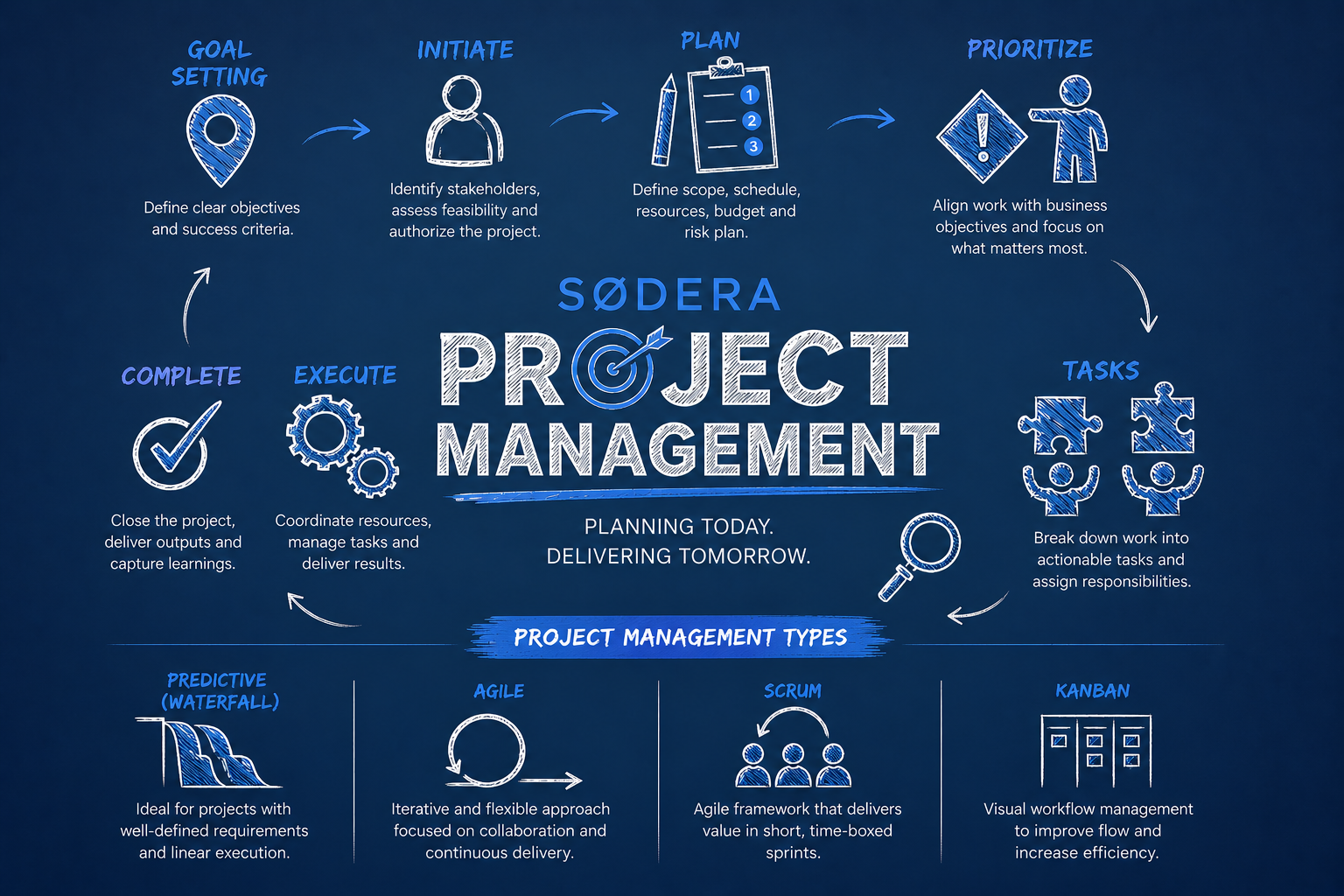
The SøDera project framework
We provide clarity, control, and efficiency for your most critical information and digital transformation initiatives. Our framework applies structured project management discipline to the specific challenges of energy sector documentation and data projects.
Project Definition and Planning
Clearly defining scope, objectives, information requirements, and success criteria. For information projects, this includes establishing the Employer Information Requirements, the data governance framework, and the handover readiness criteria before execution begins.
CDE Establishment
Setting up a robust Common Data Environment configured for the specific project and stakeholder landscape. Includes naming conventions, workflow configuration, access rights, and contractor onboarding protocols.
Execution and Monitoring
Managing resources, timelines, and deliverables with a focus on data integrity at every stage. Information quality is tracked as a project KPI alongside cost and schedule, not treated as a quality check at the end.
Quality and Compliance Control
Conducting regular data quality audits against ISO 19650 and ISO/IEC 81346 standards throughout execution. Issues identified during the project cost a fraction of those discovered during commissioning.
Risk Mitigation
Proactively identifying and addressing information-related risks before they impact the schedule. This includes contractor data quality, system integration risks, and the governance gaps that lead to Standard Drift.
Closure and Handover
Ensuring a seamless transition to operations with a verified, usable, and compliant data set. The handover package is assembled incrementally throughout the project so that closure is a structured verification, not a scramble.
A pattern we see repeatedly
When IT and Engineering cannot agree and the project stalls
The Situation
Across digital transformation projects in the energy sector, we consistently encounter the same pattern: an operator transitioning from paper-based maintenance records or legacy systems to a fully digital CMMS finds the project stalled. The reason is almost always the same. IT and Engineering are not aligned on what the new system needs to contain or how the data should be structured. Data quality issues accumulated over years make migration estimates unreliable. And there is no single owner of the information workstream who can arbitrate between the two departments.
What Good Looks Like
The resolution requires someone who understands both the technical standards governing asset information and the operational reality of the maintenance teams who will use the new system. An information-centric project management approach establishes a clear data governance framework based on ISO/IEC 81346, acts as the bridge between IT and Engineering, and ensures the new system is configured around what the operators actually need rather than what was easiest to migrate.
The Outcome
When digital transformation projects are managed with a genuine information-centric approach, they complete faster than revised estimates, with significantly higher data accuracy rates than the legacy systems they replace. The most consistent finding is a meaningful improvement in maintenance scheduling efficiency within the first year of operation, because the teams using the system can finally trust the data it contains.
Why partner with us
Expertise you can measure. Trust you can verify.
What distinguishes SøDera's project management practice is the depth of domain expertise behind every project decision. We do not manage energy information projects from a generic project management framework. We manage them with a thorough understanding of the standards, the data structures, and the operational realities that determine whether an energy information project actually delivers value.
This means we can make informed decisions about data governance, contractor performance on information deliverables, and system integration risks that a general project manager cannot. And it means the projects we manage are structured to deliver clean, usable, compliant data to operations rather than a technically complete deliverable that requires months of remediation before it is fit for use.
PMBOK
Aligned methodology
ISO 19650
Information management
20%
Fewer commissioning delays
95%+
Target data accuracy
Information projects require domain knowledge
Generic project managers cannot assess the quality of an ISO/IEC 81346 designation system or identify the governance gaps that will cause Standard Drift. We can, and we do, on every project we manage.
The bridge between IT and Engineering
Digital transformation projects fail most often at the interface between IT and Engineering. We understand both sides and can facilitate the decisions that keep projects moving.
Handover is a project discipline, not a phase
We treat handover readiness as a continuous workstream built into every project milestone, not a deliverable assembled under pressure in the final weeks of the project.
Risk identification before it becomes cost
Information-related risks, including data quality issues, contractor non-conformances, and governance gaps, are identified and addressed during execution when the cost of correction is manageable.
From our team