Bring Structure to Chaotic Documentation
Organised, accessible, and compliant systems that save time and reduce operational risks for energy assets.
"In the energy sector, structured data is not just an administrative requirement. It is the operational backbone that ensures safety, compliance, and long-term asset value. Our goal is to turn chaotic information into a strategic asset that empowers teams to work with absolute confidence."
Sylvia Awoudu · Co-founder & COO, SøDera
Understanding the discipline
What is Industrial Document Management?
Industrial Document Management (IDM) is the systematic control of technical information throughout the lifecycle of a built asset. Unlike general office filing, IDM in the energy sector is governed by the principle of Digital Continuity. According to ISO 19650, information must be managed as a structured asset, ensuring that the right person has the right information at the right time.
The core of this discipline is the Single Source of Truth. In a complex facility, a single piece of equipment such as a high-pressure pump may be referenced in hundreds of documents: P&IDs, electrical schematics, maintenance manuals, and safety procedures. Without a centralised management system, these documents often exist in multiple versions across disparate silos. Legacy archives, email threads, and local drives all hold fragments of the same information. This fragmentation leads to Information Decay, where the accuracy of the documentation set degrades by an estimated 10 to 15 percent annually due to unrecorded field changes.
Effective IDM uses metadata-driven architectures rather than simple folder structures. By tagging documents with attributes such as equipment tag numbers aligned with ISO/IEC 81346, document types, and revision status, the system enables multi-dimensional discovery. This transforms a passive archive into an active operational tool. IDM also establishes a Common Data Environment, a rigorous process for managing information exchange between project participants, ensuring that as-built data is captured incrementally rather than scrambled for at project closeout.
The cost of getting it wrong
In safety-critical environments, poor documentation is a direct liability. Research into offshore wind incidents shows that indirect costs including lost productivity, investigations, and legal liabilities are often several times larger than direct repair costs.
Consider a maintenance team dispatched to an offshore platform to repair a faulty valve. If they rely on a superseded P&ID, they may arrive with the wrong tools or spare parts. The cost of the dry run including vessel charter, technician hours, and lost production can easily exceed €20,000 for a single day. Beyond the financial impact, working with outdated safety procedures or electrical diagrams poses a severe risk to personnel.
Signs your documentation needs attention
Where we fit
Document management spans the entire asset lifecycle
Our methodology
The SøDera approach to document management
Our methodology is built on decades of practical experience within the energy sector. We do not just implement systems. We partner with your teams to embed a culture of structured information management that delivers lasting value.
Audit and Assessment
A structured review of your existing documentation to identify gaps, redundancies, and compliance risks. This assessment forms the blueprint for a customised strategy aligned with your operational needs and regulatory obligations.
Strategy Development
Designing a customised information architecture aligned with ISO 19650 and your operational goals. We define information requirements, metadata schemas, and governance frameworks before touching a single system.
Structured Filing and Metadata
Implementing logical hierarchies and robust tagging standards for instant discoverability. Documents are tagged with equipment identifiers aligned with ISO/IEC 81346, enabling teams to navigate from an asset tag directly to every related document.
Rigorous Version Control
Establishing unambiguous protocols to ensure teams always work with the latest, verified information. Every revision is tracked, attributed, and auditable. Superseded documents are flagged or archived, never silently left in place.
Digital Transformation
Guiding the migration from legacy paper or fragmented digital files to a centralised, searchable Document Management System. We support vendor evaluation, configuration, and contractor onboarding so the system is actually used.
Handover Readiness
Structuring project-to-operations handover packages so maintenance teams inherit a usable, verified document set from day one. Includes completeness verification, O&M information packs, and alignment to the asset register.
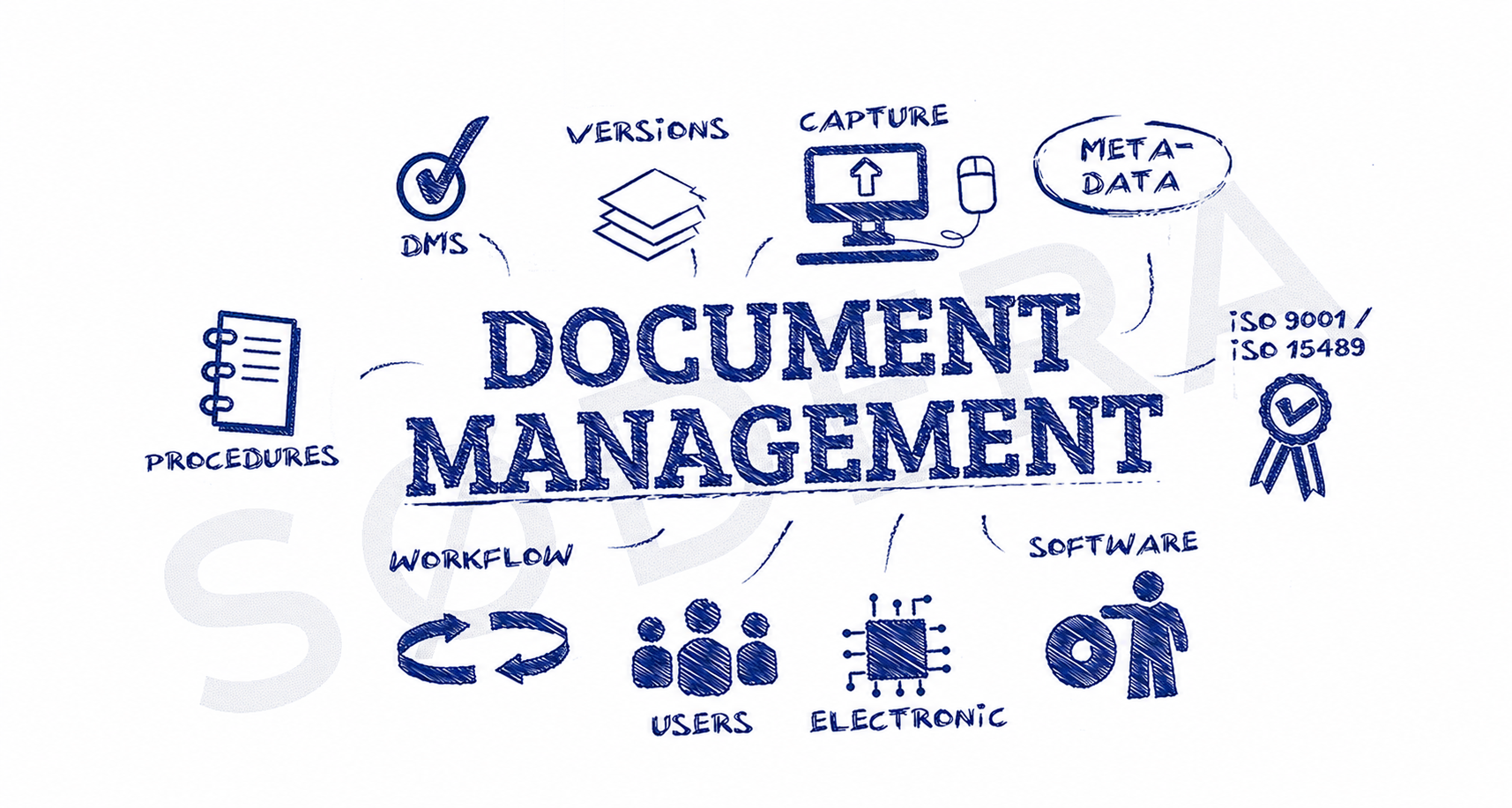
From fragmented archives to a structured information asset
Good document management is not about the system you choose. It is about the structure you put in place before you choose a system. Metadata, naming conventions, document types, and lifecycle states all need to be defined first. The software is just the container.
When the structure is right, documents become findable by asset tag, by discipline, by revision status, and by project phase. That is when documentation stops being a burden and starts being an operational tool.
A pattern we see repeatedly
When 40,000 drawings become a liability
The Situation
Across the offshore wind sector, we consistently encounter operators managing legacy archives where tens of thousands of drawings are scattered across multiple systems. Maintenance teams frequently work with superseded versions of electrical diagrams because no single source of truth exists. During planned outages, this leads to significant rework and raises serious safety concerns during live-line operations.
What Good Looks Like
The resolution in every case follows the same pattern: a comprehensive documentation audit, a new metadata-driven structure aligned with ISO/IEC 81346, and every drawing linked to its corresponding asset in a centralised Common Data Environment. Version control protocols are established and contractor submission workflows are restructured to prevent superseded documents from re-entering the active set.
The Outcome
When this work is done properly, search times for critical drawings drop from 15 minutes to under 45 seconds. Operators achieve near-complete version accuracy during subsequent maintenance cycles, eliminating rework costs and materially enhancing site safety. The structured approach then becomes the template for all subsequent projects within the portfolio.
Why partner with us
Expertise you can measure. Trust you can verify.
Choosing SøDera means partnering with experts who bring deep experience in energy sector documentation. Our work is grounded in international standards applied through hands-on project delivery across offshore wind, power plants, and industrial infrastructure.
We do not offer generic solutions. We provide tailored strategies that deliver tangible improvements to your operational resilience, compliance posture, and bottom line.
20+
Years in energy sector
ISO/IEC 81346
Asset tagging standard
ISO 19650
Information management
100%
Target version accuracy
Scattered Information
Critical documents dispersed across legacy archives, email threads, and shared drives. Engineers waste hours searching for the right drawing. A unified, structured approach is the only sustainable solution.
Version Control Failures
Multiple unsynchronised document versions leading to costly errors and compliance risks. When teams work with outdated specifications, the consequences range from rework to safety incidents.
Compliance Gaps
Missing or incomplete documentation creating substantial audit risks. Adhering to ISO 9001, ISO/IEC 81346, and applicable safety regulations demands meticulous record-keeping.
Legacy Systems Without Integration
Ageing document systems that cannot connect to CMMS, asset registers, or engineering tools. Maintenance teams cannot find documents by equipment tag.
From our team