RDS-PP: The Global Standard for Power Plant Designation
The Reference Designation System for Power Plants (RDS-PP®) is the VGB-maintained coding language that uniquely identifies every component, signal, and document in a wind turbine, solar plant, or conventional power station. SøDera helps operators and EPCs implement it correctly the first time.
"RDS-PP is an excellent naming convention for your power plants. It's well-proven and anchored in the work of true O&M specialists who came together as the "RDS-PP maintenance team." We shouldn't overlook their great work, but embrace the deep knowledge behind it."
Søren Christensen · Co-founder & CEO, SøDera
Understanding the standard
What is RDS-PP?
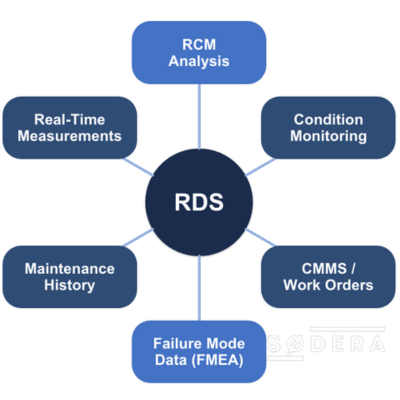
RDS-PP, the Reference Designation System for Power Plants, is a structured, object-oriented coding system used to identify every system, component, signal, terminal, and document in a power generation asset. It assigns each object a unique, machine-readable address that remains consistent from initial design through decades of operation.
RDS-PP is developed and maintained by vgbe energy (formerly VGB PowerTech), the European technical association of power plant operators. It is the de facto global designation standard for wind turbines, applied across virtually every modern offshore and onshore wind farm. While its strongest adoption is in wind, RDS-PP is designed for power plants of all kinds; thermal, hydro, solar, and decentralised generation.
RDS-PP rests on three foundations: the international ISO/IEC 81346 standard series for reference designation, the German DIN 6779-10 standard for power-plant marking systematics, and a set of VGB application guidelines that translate the abstract standards into concrete, enforceable engineering rules. Together they give RDS-PP what its successor systems often lack: fixed syntax, predefined system boundaries, and consistent rules that two engineering teams in two different countries will apply the same way.
Where it comes from
From KKS to RDS-PP: a fifty-year evolution
RDS-PP is the modern successor to KKS, the Kraftwerk-Kennzeichensystem, the German power-plant identification system developed in the 1970s. KKS was a remarkable achievement for its time. It introduced systematic coding of thermal power plant equipment and became a global reference in the conventional power generation sector.
But KKS was a national, German-language system, conceived for a world of large central thermal stations. As power generation diversified into wind, solar, and decentralised assets, and as international standards matured, the limits of KKS became increasingly visible. VGB PowerTech responded by developing RDS-PP, introduced in 2006 as a standards-aligned, internationally usable successor.
The technical lineage runs from DIN 6779-10 ("Marking systematics for technical products", the German national standard specifically tailored to power plants), upward into the international ISO/IEC 81346 series, and through the VGB application guidelines into RDS-PP itself. The most important of these guidelines is VGB-S-823-32, Application Guideline Part 32: Wind Power Plants, the document that turned RDS-PP into the global language of wind asset designation.
The three aspects of RDS-PP
Every object in a power plant can be described from three perspectives simultaneously. RDS-PP uses a dedicated prefix character for each.
Function
What the object does in the system. The functional aspect is mandatory in RDS-PP, the backbone of the designation. Used in P&IDs, alarm lists, SCADA tags, and maintenance job cards.
Product
What the object physically is. The product aspect identifies a specific piece of hardware, a particular pump, transformer, or sensor. Used in datasheets, procurement, spare parts catalogues, and installation drawings.
Location
Where the object is situated. RDS-PP uses two location levels: + for point of installation within a product (e.g. inside a cabinet), and ++ for location within a space (e.g. nacelle, tower section, substation building).
Beyond the three aspects, RDS-PP defines additional prefix categories for specific object types: ; for signals linked to a component, : for terminals, and & for documents. The rightmost prefix defines the category of the entire designation.
How the syntax works
Fixed breakdown levels, predictable structure
The defining feature of RDS-PP, and the reason it produces such consistent results across organisations, is its fixed syntax. A designation is a hierarchy: a plant-wide conjoint identifier at the top, the main systems beneath it, the systems and sub-systems within those, the basic functions they perform, and the physical products that realise them. Each level has a fixed character pattern, written here as letters (A) and digits (N).
The complete structure looks like this:
Complete designation pattern
#AA.AAANN=ANNN AAANN AANNN-AANNN
A = letter · N = digit
#AA.AAANNConjoint, the plant umbrella
The highest level: a single identifier for the whole power plant. The pattern shown is only an example. It typically encodes some combination of country, region, project identifier, and a counter, but the exact composition is a project decision. A single-country operator may use just a project identifier and drop the country and region entirely.
=ANNNMain system
The major asset sitting under the conjoint, for example G for a wind turbine generator, or T for a substation. The = prefix marks the functional aspect and is always retained wherever a functional designation appears.
AAANNSystem and sub-system
The system within that asset, coded from the VGB-B 101 library, for example MDA, the rotor system of a wind turbine.
AANNNBasic function
The specific function within the system, coded from the VGB-B 102 library, for example BT, temperature measurement.
-AANNNProduct
The physical hardware that realises the function. The leading hyphen prefix signals a product designation rather than a basic function. One function may be realised by more than one product. Together, the function (=) and product (-) describe one and the same operating equipment.
Worked example: a temperature sensor in a wind turbine
#DK.NSA01=G001 MDA10 BT002
The functional designation. Its product aspect is realised by two physical items:
-BT001
The physical temperature transmitter
-WG001
The signal cable
Conjoint shown is illustrative only
You rarely write the whole thing
The full designation is the reference form, but context lets you shorten it. Inside a given turbine, the turbine itself is already implied. Every tag in WTG =G001 belongs to that turbine, so the conjoint and main-system code are dropped and labels start at system level:
Full reference
#DK.NSA01=G001 MDA10 BT002On a label inside G001
=MDA10 BT002What never gets dropped is the = prefix. Whenever a functional designation is written, on a label, in a document, in a CMMS, the function prefix is always carried, so the designation is never ambiguous about which aspect it represents.
This whole pattern is deliberately rigid. Numbers always use leading zeros. Letters are restricted to Roman capitals excluding I and O to avoid confusion with digits. The order of letter and number blocks is fixed. The result: any engineer trained in RDS-PP can read =MDA10 BT002 and immediately know they are looking at a temperature sensor in the rotor system of a wind turbine, regardless of the OEM, country, or project.
In a substation context, a transformer system would always be identified as =T001 ATA10, whether the substation is in Germany, the UK, or Taiwan. This is the operational consistency that makes RDS-PP so valuable to fleet operators.
The two VGB classification libraries
RDS-PP draws its letter codes from two published classification libraries, both maintained by vgbe energy. These are what make the coding deterministic rather than ad-hoc.
VGB-B 101
Systems and subsystems
Three-letter codes for the main systems and subsystems of a power plant. Covers main classes A through Z across the full power-plant domain. Example: MDA for the rotor system in a wind turbine.
VGB-B 102
Basic functions and product classes
Two-letter codes for basic functions and product classes, derived from IEC 81346-2 with power-plant-specific examples. Example: BT for temperature measurement, GP for pump.
Where it is applied
Wind power leads, but the standard goes further
RDS-PP is the dominant designation system in onshore and offshore wind. The VGB-S-823-32 application guideline (Part 32) for wind power plants is treated as the de facto industry standard, applied across the OEMs, EPCs, and operators that build and run modern wind assets. For wind, the practical question is rarely whether to use RDS-PP. It is how to implement it correctly.
Beyond wind, RDS-PP is fully applicable to thermal, hydro, solar, and decentralised generation assets. The broader RDS-PP framework, supported by sister application guidelines for other power plant types, gives operators of mixed-portfolio fleets a single coding language that spans their assets, from a combined-cycle gas turbine to a battery storage facility to an offshore wind farm.
Because RDS-PP designations remain stable from design through decommissioning, and because they integrate cleanly with SCADA systems, CMMS platforms, and engineering document management systems, RDS-PP is also a foundational prerequisite for digital twins in the power sector. Unambiguous designation codes are what make plant-level sensor data, maintenance records, and engineering documents reliably joinable.
From the field
Common RDS-PP implementation pitfalls
Most RDS-PP problems are not problems with the standard. They are problems with how the standard is applied. We see the same handful of issues across asset owners, EPCs, and OEMs.
Treating VGB-B 101 / B 102 as a suggestion
Some implementations invent project-specific codes rather than using the published libraries. This breaks cross-fleet comparability and undermines the entire reason for adopting RDS-PP. The libraries exist precisely so that two turbines built by two different OEMs use the same code for the same function.
Ignoring the fixed breakdown level patterns
RDS-PP requires alternating alphabetical and numerical sections of defined length. We frequently see designations that quietly violate the pattern, extra digits, missing leading zeros, the wrong number of letters, which causes downstream validation in CMMS and SCADA systems to fail in ways that are hard to debug.
Missing the conjoint designation for wind
For wind power plants, RDS-PP defines a highly structured conjoint designation prefix (#) encoding country code, region, project name, and plant counter. When this is skipped or applied inconsistently, the operator loses the ability to compare assets across the portfolio cleanly.
Confusing function and product designations
The function aspect (=) and product aspect (-) combined describe an "operating equipment," thus the same physical object. You need both aspects to designate your assets correctly. We often see that the product level is not applied consistently but rather considered as an option. As soon as you put your finger on a physical asset, you are touching a product designation, not a function.
No governance after the design phase
RDS-PP works only if someone owns it through the asset lifecycle. We see projects where the designations were carefully built during design and then degraded over years of operations because no one was responsible for change control. The codes drift, and the digital twin slowly stops being trustworthy.
Our methodology
How SøDera implements RDS-PP
We work alongside your engineering team to embed RDS-PP correctly in your project context, whether you are specifying it on a greenfield wind farm or migrating an existing fleet to the standard.
Dialect definition
Defining the project-specific RDS-PP dialect: which application guideline applies, which optional aspects are in scope, how the conjoint designation is structured, and how deviations are managed.
Library alignment
Mapping your equipment to VGB-B 101 and VGB-B 102 with full traceability. Where the published libraries do not cover a specific asset type, we document the extension rules so they remain compliant.
Engineering integration
Embedding RDS-PP into your engineering tools, P&ID software, electrical CAD, instrument indexes, so that designations are generated and validated automatically rather than typed by hand.
SCADA and CMMS integration
Ensuring RDS-PP designations flow cleanly into your SCADA system, CMMS, and document management platform. The tag becomes the linking key across every operational system.
Legacy migration
For existing assets, systematically mapping legacy tags (KKS, in-house schemes, OEM-specific codes) to RDS-PP with full traceability. Nothing is lost. Every change is documented.
Training and governance
Hands-on training for the engineers, document controllers, and maintenance technicians who will use RDS-PP daily, combined with governance procedures that keep the system clean over decades of operations.
Why partner with us
Hands-on RDS-PP experience, not theoretical advice
SøDera works on real wind and power plant projects with real engineering teams. We bring direct experience of what goes wrong when RDS-PP is misapplied, and what it takes to put it right. We do not consult on RDS-PP from a standards document. We apply it.
Wind-sector specialism
Deep working knowledge of VGB-S-823-32 Part 32 and how it is actually applied across the OEMs and operators shaping the wind sector today.
Multi-aspect designation discipline
Function, product, and location aspects applied with the rigour the standard requires, not treated as interchangeable labels.
Lifecycle data continuity
Designations that survive from initial concept through commissioning, operations, and decommissioning, linking every system in between.
Digital twin foundation
A compliant RDS-PP framework is a prerequisite for any meaningful digital twin. We build the foundation that makes downstream digitalisation possible.
Frequently asked questions
RDS-PP, answered
What is RDS-PP?
RDS-PP, the Reference Designation System for Power Plants, is a standardised, object-oriented coding system developed by vgbe energy (formerly VGB PowerTech) for the unique identification of every system, component, signal, terminal, and document in a power generation asset. It is built on ISO/IEC 81346 and is the de facto global standard for wind turbines, applied through the VGB-S-823-32 application guideline for wind power plants.
Where does RDS-PP come from?
RDS-PP is the successor to KKS (Kraftwerk-Kennzeichensystem), the German power-plant identification system used from the 1970s onwards. VGB PowerTech developed RDS-PP to align with international standards (DIN 6779-10, ISO/IEC 81346) and to support modern asset types including wind, solar, and decentralised generation. RDS-PP was introduced in 2006 and remains under active development.
What is the difference between RDS-PP and KKS?
KKS is the legacy German power-plant coding system, defined nationally and tightly coupled to thermal power generation. RDS-PP is the modern, internationally-standardised successor. It is fully aligned with ISO/IEC 81346, supports multiple aspects (function, product, location), covers wind and renewable assets through dedicated application guidelines, and is structured to support digital twins and modern asset management.
What is the difference between RDS-PP and RDS-PS?
Both systems share the same ISO/IEC 81346 foundations, Part 1 (general rules) and Part 2 (classification of objects and coding of classes), but they have since gone in different directions. Until 2015, Part 10 of the series was a Technical Specification with a fixed-syntax, coding-led approach aligned with the VGB RDS-PP guidelines. In 2022 the ISO/IEC working group published a new edition of 81346-10 as a full International Standard: it defines RDS-PS, the Reference Designation System for Power Supply Systems, drops the fixed syntax in favour of flexible aspect-based structuring, and removes the earlier references to RDS-PP. RDS-PP remains the VGB-maintained proprietary system, with fixed breakdown levels and the VGB-B 101 and VGB-B 102 libraries, and it is still the dominant convention in wind, but the open question is alignment with the current Part 10. Because the 2022 edition no longer references RDS-PP, an operator who wants to follow the latest 81346 series end to end has the clearer path in RDS-PS, which makes it the more future-facing choice for many asset owners. For a deeper comparison, see our article RDS-PP vs RDS-PS.
Is RDS-PP only for wind power plants?
No. RDS-PP is designed for all power generation asset types; thermal, hydro, solar, and wind. It is most widely adopted in the wind sector because of the dedicated VGB-S-823-32 application guideline (Part 32), which has effectively become the industry standard. The same RDS-PP principles apply to other power plant types using the broader VGB application guidelines.
How long does it take to implement RDS-PP on a wind farm?
A greenfield wind farm with RDS-PP specified at design stage typically requires three to six months of structured implementation work. A retrofit on an existing operational asset is more variable, typically six to eighteen months depending on fleet size, data quality, and the depth of legacy tagging that needs to be mapped to the new framework. It will also depend on the level you need to fulfill your requirements. Reach out to us and we can advise you from the start.
From our team