Building Information Modelling for Energy Assets
Unlock data-driven decisions and enhanced collaboration with a digital foundation built for your asset's entire lifecycle. Aligned with ISO 19650 and ISO/IEC 81346.
"BIM is more than just 3D modelling. It is a digital ecosystem that integrates all aspects of an asset's lifecycle. For energy companies, it is the key to unlocking unprecedented levels of collaboration, data integrity, and efficiency, transforming how we build and manage critical infrastructure."
Sylvia Awoudu · Co-founder & COO, SøDera
Understanding the discipline
What is BIM in the energy sector?
Building Information Modelling (BIM) is a collaborative process for the creation and management of information on a built asset. In the energy sector, BIM extends far beyond traditional architecture to encompass complex industrial systems and infrastructure: offshore wind farms, substations, hydrogen plants, and power generation facilities. The theoretical core of modern BIM is the Common Data Environment (CDE), as defined in ISO 19650.
A CDE is a centralised digital repository where all project information including 3D models, 2D drawings, technical specifications, and maintenance data is stored and managed through a controlled workflow. The value of BIM lies in Interoperability and Digital Continuity. By using open standards such as IFC and structured designation systems such as ISO/IEC 81346, BIM ensures that information created during the design phase remains usable, linked, and accurate for maintenance operations 20 years later.
The Digital Twin is the ultimate evolution of BIM in energy infrastructure. A Digital Twin is a virtual representation that is dynamically linked to its physical counterpart through real-time data feeds. This enables Virtual Commissioning, where systems are tested in the digital environment before physical installation begins, and Predictive Maintenance, where asset condition data is visualised and analysed against the engineering model. Research indicates that BIM-enabled projects can reduce uncoordinated design changes by up to 40 percent and lower total lifecycle costs by 5 to 10 percent through better-informed facility management.
For these benefits to materialise, the BIM model must be built on a foundation of structured asset identification. Without ISO/IEC 81346 compliant designations embedded in every model element, the data cannot be reliably linked to documents, maintenance records, or sensor feeds. BIM and RDS are not separate disciplines. They are two layers of the same information architecture.
The four information layers of energy BIM
Geometric data
The 3D model: accurate spatial representation of every component, pipe, cable tray, structural element, and equipment item. The foundation for clash detection and constructability review.
Asset data
Structured non-geometric information linked to every model element: manufacturer, specification, datasheet, ISO/IEC 81346 designation, and maintenance classification. This layer is what turns a visual model into an operational tool.
Document links
Direct connections from each model element to its associated technical documents: P&IDs, manuals, inspection records, and safety procedures. Powered by the RDS tag as the common identifier.
Live operational data
For Digital Twin implementations, real-time sensor feeds, SCADA data, and condition monitoring results linked to the model. Enables predictive maintenance and anomaly detection at the asset level.
The cost of physical clashes
In complex energy projects, clashes occur when two components such as a pipe and a structural beam occupy the same physical space. Without BIM-led design coordination, these are typically discovered during construction when correction is most expensive.
In a specialised industrial project such as a hydrogen pilot plant, a single major piping clash discovered during installation requires stopping work, re-engineering the piping layout, procuring new materials, and potentially delaying the entire project schedule. The cost of a single major clash resolution can easily reach €150,000 in direct rework and indirect delay costs. BIM identifies these clashes in the digital model months before construction begins, allowing for zero-cost resolution in the design phase.
Where BIM fits
BIM creates the digital foundation that spans the entire asset lifecycle
Our methodology
The SøDera BIM framework
We guide energy organisations through every stage of their BIM journey, from initial strategy through to operational digital twin. Our approach is grounded in the energy sector context, not adapted from construction or architecture practice.
BIM Strategy Development
Defining BIM execution plans, Employer Information Requirements (EIR), and organisational goals. The strategy determines what information you need, when you need it, and who is responsible for producing it.
CDE Implementation
Establishing a robust Common Data Environment for seamless stakeholder collaboration across disciplines and contractor boundaries. Includes workflow configuration, naming conventions, and access control.
Model Development and Management
Creating data-rich 3D models with structured asset attributes linked to ISO/ISO/ISO/IEC 81346 designations. Every model element carries the information needed to support operations, not just geometry for construction.
Standard Alignment
Ensuring all models and data structures comply with ISO 19650 and ISO/IEC 81346. This is the layer that makes the model useful beyond handover, connecting it to CMMS, asset registers, and document systems.
Implementation and Integration
Guiding engineering teams through BIM workflows and integrating models with existing maintenance management systems. Adoption requires training, process change, and support, not just software.
Lifecycle Optimisation
Linking BIM data to real-time operational parameters for predictive maintenance and performance monitoring. This is where the model transitions from a project deliverable to a living operational asset.
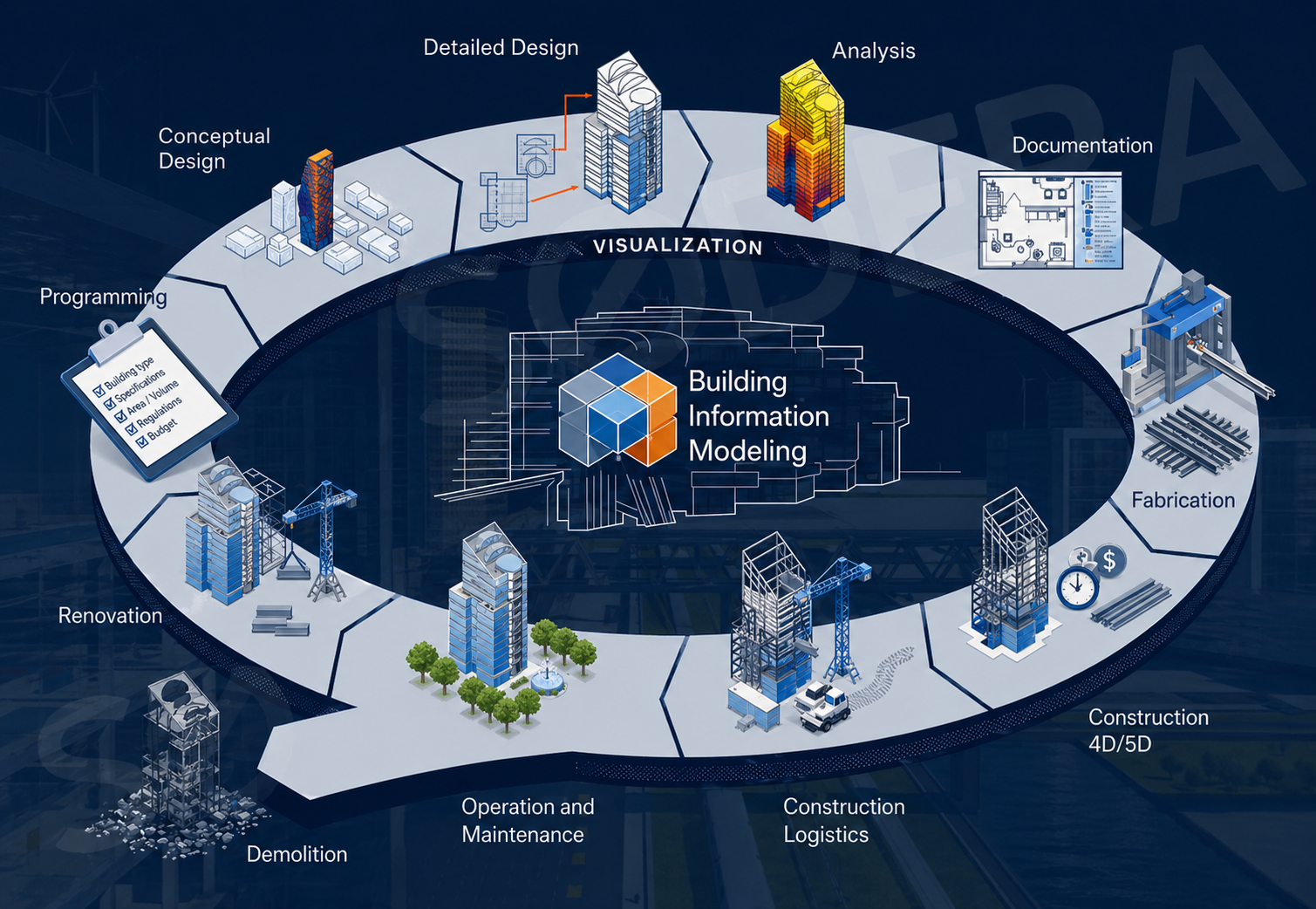
From a project model to an operational asset
The model does not stop being useful at handover. When it is built correctly from the start, with structured asset data and ISO/ISO/ISO/IEC 81346 designations embedded in every element, it becomes the operational foundation that maintenance teams, engineers, and asset managers rely on throughout the lifecycle.
This is the difference between a BIM deliverable and a BIM foundation. One gets archived. The other gets used every day.
A pattern we see repeatedly
When complexity makes coordination the biggest risk
The Situation
In pioneering energy projects with multiple international partners and highly complex piping layouts, we consistently see the same challenge: coordination between disciplines happens too late and too informally. Clashes between mechanical, electrical, and structural elements are discovered during construction rather than during design. On specialised industrial projects, the consequences include stopped work, re-engineering, procurement delays, and significant cost overruns that could have been prevented entirely.
What Good Looks Like
The resolution follows a consistent pattern: a CDE established early in the design phase, a BIM-led design review process replacing informal coordination meetings, and every component in the 3D model tagged according to ISO/IEC 81346. This creates direct links between model elements and their technical specifications and safety procedures. Clash detection is automated and continuous rather than manual and periodic. Issues are resolved in the digital model before a single component is fabricated.
The Outcome
When BIM is implemented properly on complex energy projects, hundreds of physical clashes are identified and resolved digitally before construction begins. At handover, the operations team receives an intelligent model rather than a static drawing set, enabling maintenance tasks to be visualised in 3D before engineers enter high-pressure or hazardous environments. The model becomes an operational asset that continues to deliver value throughout the facility's lifecycle.
Why partner with us
Expertise you can measure. Trust you can verify.
SøDera brings a rare combination to BIM engagements: deep understanding of both the information management standards and the operational reality of the energy assets being modelled. We do not just build models. We build models that are useful for the people who will maintain the facility for the next 30 years.
Our approach connects BIM directly to the RDS and document management practices that govern how asset information is used in operations. This integration is what turns a BIM deliverable into a genuine operational foundation rather than a project closeout artefact.
ISO 19650
BIM information management
ISO/IEC 81346
Asset data structuring
40%
Reduction in design clashes
Digital Twin
Ready model delivery
Models built for operations
Every model element carries structured asset data linked to ISO/ISO/ISO/IEC 81346 designations. The model is useful from day one of operations, not just during construction.
Connected to your information landscape
BIM models integrated with document management systems, CMMS platforms, and asset registers so information flows without manual re-entry or duplication.
Digital twin foundation
Models structured for live data integration, enabling the transition from a static handover deliverable to a dynamic digital twin as operational data becomes available.
Standard-aligned from the start
ISO 19650 and ISO/ISO/IEC 81346 compliance built into the model from the first element, not retrofitted at handover. This is what makes the model trustworthy for lifecycle use.
From our team