Table of contents
I have spent over a decade in document management and information management across energy and offshore projects, and these days most of my working hours go into object type libraries, OTL mapping and asset data analysis in the energy sector. So let me be upfront: I am not a 3D modelling specialist, and this article is not written from the modelling side. It is written from the data side, which is where validation actually succeeds or fails. Also if there is one term I see used loosely more than any other right now, it is BIM validation. In buildings, validation usually means clash detection and model coordination. In energy infrastructure, that definition is not just incomplete. It is dangerous.
A substation, a converter station, a wind farm or a transmission corridor is not a building. The geometry matters, but the geometry is not what the operator runs the asset on for the next forty years. The data is, and in 2026, with Europe committing to the largest grid buildout in its history, the gap between validated geometry and validated data is where projects quietly lose millions.
Why this matters right now
The European Commission published its European Grids Package in December 2025, and the legislation is a priority file for 2026. The scale of the challenge is substantial: the Commission estimates that €1.2 trillion of investment in electricity transmission and distribution grids will be needed by 2040, while ENTSO-E says Europe needs more than 100,000 kilometres of new onshore and offshore lines by 2030. Meanwhile, the Commission has proposed increasing the Connecting Europe Facility's energy budget roughly fivefold, from €5.84 billion to €29.91 billion, under the EU's 2028 - 2034 budget.
Every one of those kilometres, every substation, every converter platform, produces an information asset alongside the physical one. Owners know this. Contractual requirements for structured digital documentation are now standard practice on major programmes, and transmission system operators are designing entire programmes around standardisation. The wave of standardised multi gigawatt HVDC grid connection programmes now running in the North Sea is the clearest example: a one design fits all philosophy only pays off if the information describing the assets is equally standardised and equally repeatable.
Here is the uncomfortable part. Most of that information arrives at handover unvalidated. Not the models, the data inside them.
What BIM validation means when the asset is a grid
In energy infrastructure, validation has three layers, and most projects only do the first one properly.
Layer one is geometric validation. Clash detection, spatial coordination, constructability. The industry is genuinely good at this now. AI assisted checking has matured to the point where irrelevant clashes get filtered automatically and review time drops significantly. It is also the layer I am least involved in day to day, and honestly, it is the layer that needs the least help. If your BIM consultant talks only about this layer, they are selling you a buildings workflow.
Layer two is alphanumeric validation. Does every object in the model carry the attributes the operator needs? Are the values populated, in the right format, in the right units, against the right classification? This is where energy projects bleed, and this is my daily work. I map supplier deliverables against object type library requirements, and I have tracked asset databases where attribute completion across tens of thousands of required attribute rows sat at zero percent late into a project. Nobody had validated data entry because the requirement lived in a PDF that no software could check against.
Layer three is reference validation. Does the model speak the same language as the operator's asset register, maintenance system and control system? In energy, this means reference designation systems, for example RDS-PP in existing power-plant environments, or structures based on the IEC/ISO 81346 series. An object can be geometrically correct and fully attributed, yet still fail operational handover if its designation cannot be reconciled with the identifier used by the operator's CMMS or other operational systems. Reference validation is therefore a critical part of the handover test: it establishes whether project information can be reliably connected to the corresponding operational asset.
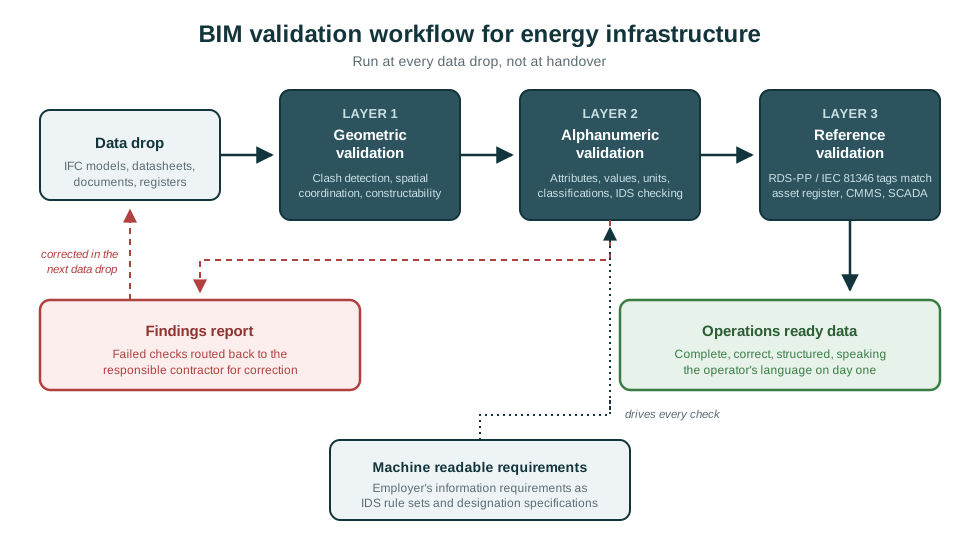
The three layers of BIM validation in energy infrastructure. Findings from every layer route back to the responsible contractor and get corrected in the next data drop, driven by machine readable requirements.
Key Insight: In energy infrastructure, BIM validation is not a modelling activity. It is a data quality activity that happens to use models. The question is never whether the model looks right. It is whether an operator can run maintenance, safety and asset management processes from the data inside it on day one of operations.
What changed in 2025 and 2026
Three developments have moved validation from a manual review exercise to something you can actually automate, and if your project is not using them, you are running a 2019 process on a 2026 programme.
First, machine-readable requirements became a real standard. The Information Delivery Specification, IDS, became an official buildingSMART standard in June 2024. It turns information requirements into computer-interpretable rules that can be checked automatically against IFC models. An IDS can specify required entities, classifications, properties, values and units, with compliant implementations intended to produce consistent checking results. Instead of leaving every information requirement buried in prose or spreadsheets, the requirements that IDS can express can become machine-checkable rules. For utilities, that is one of the most practical developments in recent years because it creates the possibility of continuous layer-two validation rather than discovering information-quality problems at handover.
Second, the digital-twin agenda made data quality a strategic issue. In January 2026, ENTSO-E and the EU DSO Entity published a joint report defining concrete digital-twin use cases across transmission and distribution, covering flexibility, hosting capacity, resilience and coordinated security assessment. ENTSO-E followed in February with a report advocating a federated approach based on shared semantics, open standards and common governance rather than a single centralised platform. The implication for capital projects is important: sophisticated operational twins depend on reliable, interoperable source data. If the asset information arriving from projects has not been validated, the digital twin inherits those weaknesses.
Third, information validation is moving upstream. Dodge Construction Network research found that 66 percent of owners using digital workflows said those workflows frequently result in better-informed project decisions. In the programmes I see, that shift is increasingly visible in procurement: structured information requirements arrive with the tender rather than being defined after award. That changes the contractor's risk profile. If the required information structure and validation process are not understood at bid stage, the cost of achieving compliant digital handover can easily become an unpriced delivery risk.
Where energy projects actually fail validation
After years inside these programmes, the failure patterns are remarkably consistent.
The requirements are not checkable. If your information requirements live in a PDF or a spreadsheet with free text descriptions, no tool can validate against them. Translating them into IDS or equivalent rule sets is the first real step, and it usually exposes that the requirements themselves are ambiguous.
Validation happens at handover instead of continuously. Checking two years of accumulated modelling in the final months before energisation guarantees findings you no longer have time or budget to fix. Validation belongs in every data drop.
Geometry and data are validated by different people who never talk. The BIM coordinator checks clashes. The document controller checks metadata. Nobody checks that the tag on the model object, the tag in the datasheet and the tag in the asset register are the same tag.
The reference designation layer is treated as an afterthought. Designation systems get agreed late, applied inconsistently across contractors, and reconciled manually at the end. On a multi contractor HVDC programme this single issue can generate months of rework.
Manual review versus rule based checking versus IDS validation
| Manual review | Proprietary rule checking | IDS based validation | |
|---|---|---|---|
| Requirements format | Prose documents, PDFs | Vendor specific rule files | Open, machine readable standard |
| Consistency of results | Depends on the reviewer | Depends on the tool | Identical across compliant tools |
| Coverage | Samples, best effort | High within one platform | Full model, every data drop |
| Contractual usability | Weak, open to interpretation | Locked to a vendor | Strong, requirements are executable |
| Best suited for | Early design reviews, judgement calls | Established single platform workflows | Multi contractor energy programmes |
Manual review still has a place. Judgement does not automate. But on utilities and energy infrastructure programmes with multiple contractors, long timelines and operators who will live with the data for decades, open standard automated validation is no longer optional.
Final Word
Europe is about to spend more than a trillion euros on grids, and every operator involved will inherit the data quality decisions being made on projects right now. BIM validation in this sector is not about prettier models. It is about whether the asset information arriving at handover is complete, correct, structured and speaking the operator's language. The tools to guarantee that exist today. Most projects simply have not wired them in.
If you are running or joining an energy infrastructure project and you cannot say with confidence what percentage of your required asset attributes are currently populated and valid, that is the question to answer first. At SøDera we run structured assessments of exactly this: your information requirements, your validation workflow and the gap between your project data and what operations will actually need. It takes days, not months, and it tells you where you stand before the findings become expensive. Get in touch and we will take a look.