Table of contents
This autumn, another multi gigawatt offshore wind project reached financial close. Twelve billion pounds arranged, 2.8 gigawatts to build, press releases everywhere. I read those announcements differently than most people, because I have spent over a decade in document and information management across energy and offshore wind, and I know what happens in the weeks after the champagne.
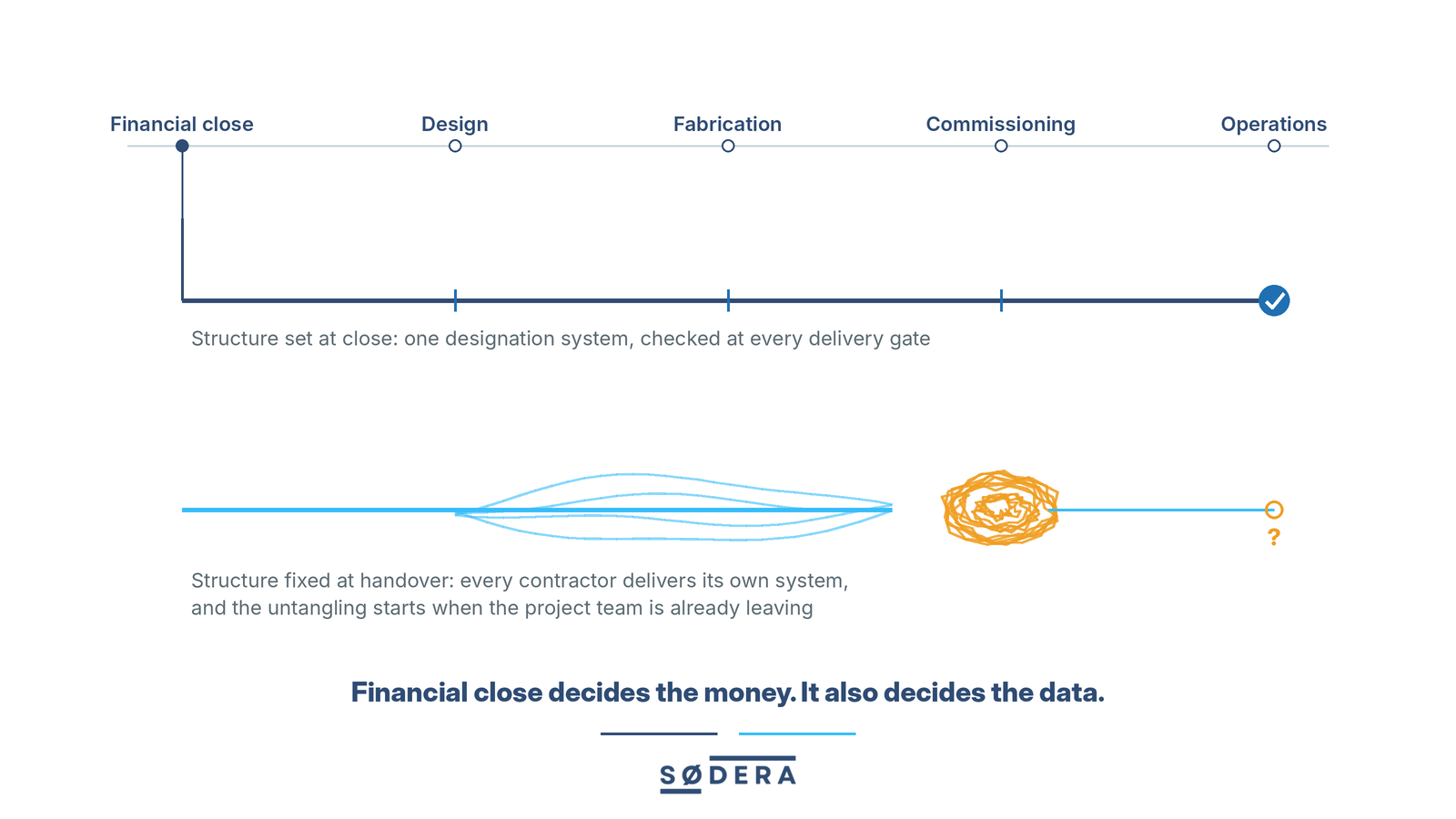
Financial close is the day the money gets sorted. It is also the day the asset data structure quietly gets decided. Not in a workshop, not in a strategy session. It gets decided by whatever information requirements are sitting in the contract schedules at the moment they become binding. If those schedules name a designation system and say who applies it and how it is checked, the project has a data structure. If they do not, the project has twenty of them, one per contractor, and the owner finds out at handover.
What financial close on a 2.8 GW project actually triggers
The moment financing closes, the project stops being a plan and becomes a machine. EPCI packages activate. Turbine supply, foundations, array cables, export cables, substations, each with its own contractor, its own engineering tools and its own habits. Within weeks, hundreds of engineers start producing drawings, models, datasheets and tag lists.
Every one of those documents identifies assets somehow. The question is whether they all identify assets the same way. The contract schedules frozen at close are the only instrument the owner has to make that happen, because after close, every change to a contractor's deliverable requirements is a variation, and variations cost money.
This is the part that surprises people who come to asset data from the finance side: the data structure is not a technical detail that gets tidied up later. It is a contractual outcome. It was priced, or not priced, on the day the deal closed.
Where asset data breaks on the way to operations
The damage follows a pattern. I have seen versions of it on enough projects that I can describe it phase by phase without naming anyone.
In design, each discipline numbers its own world. Electrical has its codes, structural has its own, the turbine supplier has a system it uses on every project regardless of what yours says. Nothing is wrong yet. Everything is just different.
In fabrication, manufacturer serial numbers enter the picture. A transformer now has a works number, a purchase order reference, a drawing number and a project tag, and the links between them live in spreadsheets maintained by whoever needed the link that week.
In commissioning, systems get reorganised around energisation and test packages. Assets are regrouped by commissioning logic, which is not design logic and not operations logic. New identifiers appear because the test team needs them and cannot wait.
At operations, all of it lands at once. The maintenance system needs one clean register of assets, each with one identity, linked to its documents, spares and test records. What arrives instead is a set of deliveries in different structures, and someone gets hired to map them to each other. That mapping work is slow, expensive and error prone, and it happens exactly when the project team is demobilising and the knowledge is walking out of the door.
None of these phases broke the data. Every phase did something locally sensible. The structure broke in the handoffs, because no single structure was ever made binding on everyone.
Key insight: the designation system of a project is decided on the day the first contract becomes binding. The only choice an owner really has is whether it is decided on purpose, in the contract, or by accident, at handover.
Why IEC 81346 and RDS-PP belong in the contract, not the punch list
The tools for deciding it on purpose already exist, and they are public standards, not proprietary systems.
The ISO/IEC 81346 series defines structuring principles and reference designations for industrial systems: how to identify an object by its function, its product and its location, in one coherent system. For power plants including wind, RDS-PP is the established application of the series, maintained with application guidelines by vgbe energy. IEC 81346-10 defines RDS-PS for power supply systems. IEC 61355 does the same job for classifying the documents that describe the assets. These standards exist precisely so that a turbine supplier, a cable contractor and an owner's maintenance system can speak one language without inventing it per project.
What makes them work is not citing them. It is contracting them. A line in an employer's information requirements saying "assets shall be designated per IEC 81346" changes nothing on its own, because the series allows choices, and every contractor will make different ones. What changes outcomes is a contract schedule that names the variant, references the application guideline, states who assigns designations and when, and defines how each delivery is checked against the requirement before it is accepted.
Checked is the operative word. I wrote recently about rule-based validation of information deliveries, and the same logic applies here: if the requirement is written so it can be checked by a rule, it will be followed. If it can only be checked by opinion, it will be negotiated.
The alternative is the punch list. Fixing designations at handover means recoding hundreds of thousands of objects under time pressure, by the few people left who remember what things are, while the operations team waits for a usable asset register. I have watched owners pay for their asset data twice: once inside the EPCI contracts, and once more to make it usable.
The first 90 days after close: a practical checklist for owners
If a project has just closed and the schedules are thinner on information requirements than they should be, the window for cheap corrections is short but real. This is what I would do in the first ninety days.
Name the structure. Decide the designation standard and variant, for offshore wind typically RDS-PP per the vgbe application guidelines, and the document classification, typically IEC 61355. Write the decision down as a project document with an owner.
Write the application guideline. The standard allows choices. Your guideline makes them: aspects used, structure levels, numbering rules, who assigns what. Keep it short enough that contractors actually read it.
Get it into the packages. For contracts not yet signed, the guideline goes into the asset information requirements before signature. For contracts already binding, agree it as a clarification now, while goodwill is high and nobody has produced thousands of deliverables against the wrong structure yet.
Define the delivery gates. Every document and data delivery gets checked against the guideline with written, repeatable rules. First deliveries get checked hardest, because that is when correcting a contractor's setup costs one meeting instead of one recoding campaign.
Appoint one owner of the structure. Not a committee. One person who answers designation questions within days, keeps the guideline current and has the authority to reject non-conforming deliveries.
Pilot on one package. Run one contractor's first delivery through the full loop, requirement, delivery, check, feedback, and fix the guideline where it proved ambiguous. Then scale.
Structure set early vs fixed late
| Set at financial close | Fixed at handover | |
|---|---|---|
| Who defines the structure | The owner, once, in the contract | Each contractor, separately, by habit |
| Cost of the structure | Hours of specialist work, priced into packages | A remapping project, paid again by the owner |
| Contractor deliveries | Checked against written rules at each gate | Accepted as delivered, repaired later |
| Commissioning | Works in the same structure operations will use | Invents its own identifiers under time pressure |
| Loading the maintenance system | Import against one register | Manual mapping across structures |
| Knowledge at the critical moment | Captured in the guideline and the data | In the heads of a demobilising project team |
| Operations day one | One asset, one identity, documents linked | Asset hunting, duplicate records, open punch items |
The final word
Nobody celebrates asset data at financial close, and nobody should. The milestone belongs to the people who arranged the financing. But the owners who end up with clean data in operations are the ones who understood that the same signatures that fixed the money also fixed the window for fixing the data structure. Ninety days of unglamorous work right after close buys a decade of maintenance teams finding the right asset on the first try.
If your project has closed and you are not certain the information requirements in your packages would survive contact with five contractors, that is worth finding out now rather than at handover. At SøDera we help owners and developers set up designation structures and object type libraries, application guidelines and delivery checks that hold from contract to operations. Our assessment starts with your existing requirements and one sample package, and tells you what is enforceable today and what needs fixing while it is still cheap.
Sources
- ISO/IEC 81346 series, Industrial systems, installations and equipment and industrial products: structuring principles and reference designations
- IEC 81346-10:2022, Reference designation system for power supply systems (RDS-PS)
- vgbe energy, RDS-PP Reference Designation System for Power Plants, application guidelines including wind power plants: https://www.vgbe.energy
- IEC 61355-1, Classification and designation of documents for plants, systems and equipment
- NIST GCR 04-867, Cost Analysis of Inadequate Interoperability in the U.S. Capital Facilities Industry
About the author

Co-founder and COO at SøDera | Object type library implementation and asset information requirements
Sylvia implements object type libraries and asset information requirements for energy infrastructure, with over a decade in document and information management.
Not sure where to start?
Book an assessment
A focused, paid review that usually takes two weeks. You get a clear picture of where you stand and what to fix first.
Book assessment