Real-Time Intelligence for Your Physical Assets
Create a dynamic virtual replica of your energy infrastructure to optimise performance, predict failures, and transform how you make operational decisions across the full asset lifecycle.
"The Digital Twin is the ultimate realisation of data-driven asset management. It transforms static information into dynamic intelligence, allowing us to not just react to problems, but to predict and prevent them, fundamentally changing how we design, operate, and maintain critical energy infrastructure."
Sylvia Awoudu · Co-founder & COO, SøDera
Understanding the discipline
What is a Digital Twin in the energy sector?
A Digital Twin is a virtual representation of a physical asset, process, or system that is continuously updated with real-time data from its physical counterpart. In the energy sector, this concept is transforming asset management from reactive to predictive. A Digital Twin is not a 3D model or a static documentation set. It is a dynamic, living replica of the physical world that enables advanced analytics, operational simulations, and genuinely informed decision-making.
The foundation of a robust Digital Twin rests on several interconnected pillars. Data Integration brings together information from diverse sources including sensors and IoT devices, SCADA systems, CMMS, and engineering documents structured through BIM and ISO/IEC 81346. Without a standardised information architecture, this data aggregation is either impossible or produces a system that cannot be trusted. Real-time Synchronisation ensures the virtual model accurately reflects the current condition of the physical asset through robust data pipelines.
Advanced Analytics enables machine learning algorithms to process large volumes of operational data, identify degradation patterns, predict potential failures before they occur, and optimise asset performance parameters. Simulation capability allows operators to run what-if scenarios and test operational changes in the digital environment before implementing them in the physical one, eliminating the risk of costly trial and error on live assets.
The returns from well-implemented Digital Twins in the energy sector are consistently significant. Research demonstrates reductions in unplanned downtime of between 25 and 42 percent, decreases in maintenance-related incidents of between 35 and 50 percent, and meaningful extension of asset operational lifespan. These outcomes are achievable, but only when the Digital Twin is built on a foundation of clean, structured, ISO/IEC 81346 compliant asset identification.
The four pillars of a functional Digital Twin
Each pillar must be in place. A Digital Twin without structured asset identification cannot aggregate data reliably. One without real-time synchronisation is just a static model.
Data Integration
Aggregating data from sensors, SCADA, CMMS, and engineering documents into a unified information architecture built on ISO/ISO/IEC 81346 and ISO 19650. The quality of the Digital Twin is determined entirely by the quality of this foundation.
Real-time Synchronisation
Robust data pipelines and communication protocols ensuring the virtual model accurately and continuously reflects the current state of the physical asset. Latency and data loss at this layer undermine every other capability.
Advanced Analytics
Machine learning models that process operational data to identify patterns, predict component degradation, and surface actionable insights. This is where the Digital Twin moves from observation to prediction.
Simulation and Optimisation
The ability to run what-if scenarios in the digital environment before making changes to the physical asset. Test maintenance schedules, operational parameters, and response plans without touching the live system.
The cost of unplanned downtime
In the energy sector, unplanned downtime of critical assets can lead to massive financial losses, regulatory penalties, and in extreme cases, grid instability. Without a Digital Twin, maintenance is often scheduled based on fixed intervals or triggered by failure, both of which are suboptimal for complex, high-value assets.
Consider a major power transformer in a substation. If a critical internal component degrades undetected and fails unexpectedly, the cost of the resulting outage can be extraordinary. For a large generation asset, lost revenue alone can reach €500,000 per day, before emergency repair costs and potential regulatory penalties are added. A Digital Twin continuously monitoring the transformer's condition can predict such failures weeks or months in advance, enabling scheduled preventive maintenance and avoiding catastrophic unplanned outages entirely.
From static model to living intelligence
A Digital Twin is only as good as the data beneath it. When ISO/ISO/IEC 81346 compliant asset identification is in place, every sensor reading, maintenance record, and engineering document links to the same asset identifier. The model becomes a single point of truth rather than one more data source to reconcile.
That is the difference between a visualisation tool and genuine operational intelligence.
Our methodology
The SøDera Digital Twin framework
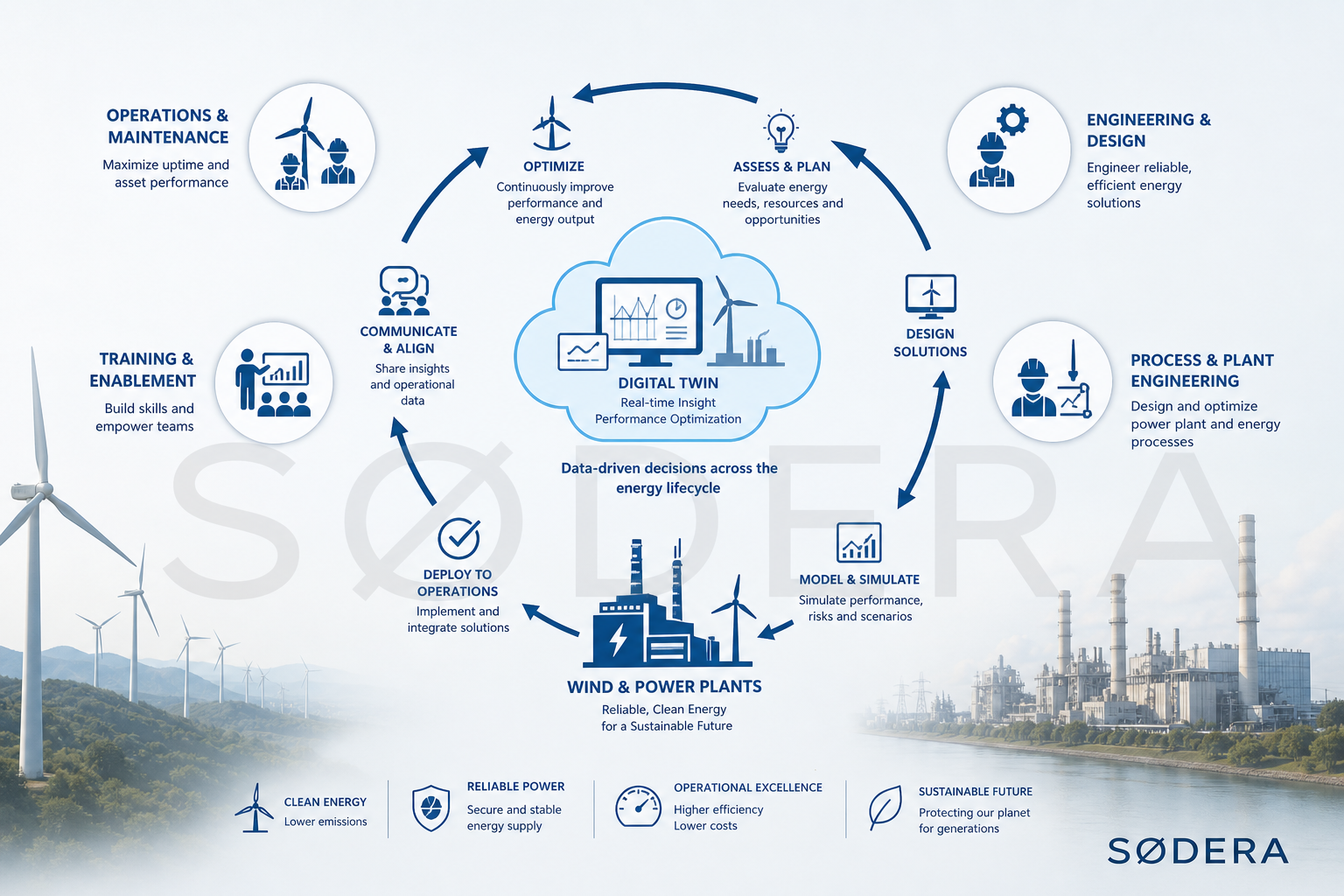
We guide operators through the entire Digital Twin lifecycle, from initial feasibility assessment through to operational deployment and continuous improvement. Our approach is grounded in the understanding that a Digital Twin is only as good as the information architecture beneath it.
Feasibility and Strategy
Assessing your current assets, data landscape, and operational goals to define a clear Digital Twin roadmap. Not every asset justifies a full Digital Twin immediately. We help you prioritise where the investment delivers the highest return.
Data Integration and Harmonisation
Connecting diverse data sources including IoT sensors, SCADA systems, CMMS records, and BIM models, and structuring the information using ISO/IEC 81346 as the linking standard. This foundation determines the reliability of everything built on top of it.
Model Development
Creating high-fidelity 3D models integrated with real-time operational data. Every model element is tagged with ISO/IEC 81346 compliant designations so that sensor data, maintenance records, and engineering documents all link to the same asset identifier.
Analytics and AI Layer
Developing predictive models and AI algorithms to extract actionable insights from operational data. This layer translates raw sensor readings into meaningful operational intelligence: predicted failure windows, anomaly alerts, and performance optimisation recommendations.
Simulation and Optimisation
Building what-if scenario capabilities to test operational changes and optimise asset performance without risk to the physical asset. Maintenance schedules, load profiles, and emergency response procedures can all be tested digitally before implementation.
Deployment and Training
Implementing the Digital Twin platform and training your teams to use it effectively for day-to-day decision-making. A Digital Twin that is not embedded in operational workflows delivers no value. We ensure adoption is structured and sustained.
A pattern we see repeatedly
When reactive maintenance becomes operationally unsustainable
The Situation
Across offshore wind fleets, we consistently see operators experiencing high maintenance costs and significant unplanned downtime from unexpected failures of critical components such as gearboxes and generators. The root cause is rarely poor maintenance practice. It is the absence of early warning. Without visibility into component degradation trends, the first indication of a problem is the failure itself, at which point the cost and logistics of offshore intervention are at their highest.
What Good Looks Like
A Digital Twin built on clean ISO/IEC 81346 compliant asset identification integrates real-time sensor data from each asset with historical maintenance records and engineering specifications. Advanced predictive models are trained on this combined data to identify the signature patterns that precede component degradation and failure. Maintenance interventions are then scheduled at the optimal point in the degradation curve: late enough to minimise unnecessary maintenance, early enough to prevent failure entirely.
The Outcome
When Digital Twin implementation is done properly on offshore wind fleets, operators consistently achieve meaningful reductions in unplanned downtime and maintenance costs within the first year of operation. The shift from reactive to predictive maintenance optimises vessel usage, reduces the frequency and cost of offshore interventions, and materially extends the operational lifespan of critical components across the fleet.
Why partner with us
Expertise you can measure. Trust you can verify.
What distinguishes SøDera's Digital Twin practice is that we start from the information architecture, not from the visualisation layer. Most Digital Twin failures we see in the energy sector trace back to the same root cause: the underlying asset identification was not structured, not compliant, and not consistent enough to support reliable data aggregation. We solve this problem first, which is why the Digital Twins we support actually deliver operational value.
25-42%
Reduction in unplanned downtime
35-50%
Fewer maintenance incidents
ISO/IEC 81346
Data foundation standard
Real-time
Dynamic operational intelligence
Information architecture first
We build the ISO/ISO/IEC 81346 and ISO 19650 foundation before connecting sensors or building models. A Digital Twin built on poorly structured data will not deliver reliable predictions regardless of the analytics layer above it.
From BIM to live Digital Twin
We bridge the gap between the static BIM model delivered at handover and a genuinely dynamic Digital Twin. The BIM model is the starting point. The live operational data is what makes it intelligence rather than documentation.
Lifecycle continuity
Digital Twins that are built during design and updated through commissioning and operations provide the deepest value. We structure engagements to build the foundation early and evolve the capability across the full asset lifecycle.
Grounded in energy sector reality
Our Digital Twin practice is built on direct experience of how energy assets are operated, maintained, and handed over. The models we build reflect operational reality, not laboratory conditions.
From our team