Master the Universal Language of Assets
Implement the ISO/IEC 81346 standard series to create a robust, object-oriented foundation for your industrial data. The prerequisite for Digital Continuity, BIM, and Digital Twin in energy infrastructure.
"ISO/IEC 81346 is not just a tagging standard. It is a philosophy of information. It is the only standard that truly understands the multi-dimensional nature of industrial assets, providing the structure needed for the digital transformation of the entire energy sector."
Søren Christensen · Co-founder & CEO, SøDera
Understanding the standard
What is the ISO/IEC 81346 standard series?
The ISO/ISO/IEC 81346 standard series, titled Industrial Systems, Installations and Equipment and Industrial Products, Structuring Principles and Reference Designations, is the international benchmark for asset identification. It is co-published by the International Electrotechnical Commission (IEC) and the International Organization for Standardization (ISO), making it a genuinely global and cross-disciplinary standard applicable across every industry that builds and operates complex physical systems.
The theoretical core of ISO/IEC 81346 is Object-Oriented Structuring. Unlike traditional flat tagging systems that identify objects based on a single characteristic, ISO/IEC 81346 recognises that any object in an industrial system can be viewed from multiple aspects simultaneously. The Function aspect describes what the object is intended to do. The Product aspect describes how the object is constructed or what it physically is. The Location aspect describes where the object is situated.
This multi-aspect approach is the key to Digital Continuity. It allows information from different engineering disciplines including Process, Electrical, Mechanical, and Civil to be linked to the same physical object through a consistent, hierarchical address. The same pump can be identified by its functional role in a system (=), its physical product specification (-), and its installation location (+) simultaneously. Each aspect has its own legitimate use, and the standard provides the rules for how they combine.
This structure is the essential prerequisite for BIM (ISO 19650) and the creation of Digital Twins. Without the rigorous structure of IEC 81346, industrial data remains siloed and fragmented across disciplines and systems. Organisations that fully adopt the object-oriented principles of ISO/IEC 81346 consistently experience fewer engineering coordination errors and significantly lower data integration costs across the asset lifecycle.
The three aspects of ISO/IEC 81346
Every industrial object can be described from three independent perspectives. ISO/IEC 81346 provides a rigorous structure for each.
Function
What does it do?
The functional role of the object within the system. Independent of what the object physically is or where it is located. Used in P&IDs, alarm lists, maintenance job cards, and SCADA function assignments.
A pumping function, a control function, a protection function.
Product
What is it?
The physical product or component. Independent of where it is installed or what function it performs. Used in datasheets, procurement, spare parts lists, and installation drawings.
A centrifugal pump, a circuit breaker, a pressure transmitter.
Location
Where is it?
The physical installation location. Independent of what is installed there or what function is performed. Used in construction drawings, access routes, and zone or module references.
Pump room A, module 3, turbine nacelle, substation bay 4.
The cost of siloed data
In large-scale industrial projects, different engineering disciplines typically use their own internal tagging logic. This creates Information Silos where the same physical valve carries four different names across four different systems: one in the process documentation, one in the electrical drawings, one in the maintenance system, and one on the physical label in the field.
During a facility commissioning phase, a safety-critical interlock fails to trigger. The electrical team looks for one identifier, the process team looks for another, and the maintenance team looks for a third. The confusion and manual tracing required to verify these all refer to the same physical object can delay commissioning by days. In a high-stakes commissioning environment, a three-day delay caused by tag inconsistency can cost an operator over €60,000 in specialised labour and lost production revenue. ISO/IEC 81346 eliminates this by providing a single multi-aspect identifier that is the authoritative reference for all disciplines simultaneously.
Our methodology
The SøDera ISO/IEC 81346 framework
We help you master and implement the standard to create a world-class information architecture. Our approach is grounded in field experience of applying ISO/IEC 81346 in real energy projects with real engineering teams across multiple disciplines.
Maturity Assessment
Evaluating your current designation practices against the requirements of ISO/IEC 81346. We identify where your existing system aligns with the standard, where it diverges, and what the practical risk of those divergences is for your operations.
Structuring Principles
Defining the hierarchical levels and aspect rules specific to your facility and operations. No two facilities are identical. The structuring principles must reflect your operational reality while remaining compliant with the standard.
Letter Code Selection
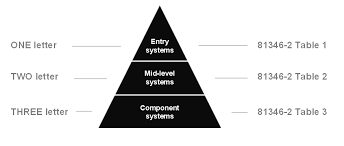
Implementing the standardised letter codes from ISO 81346-2 for consistent object classification across all disciplines. This is the layer that makes the designations machine-readable and interoperable with other standard-compliant systems.
Cross-Disciplinary Alignment
Ensuring all engineering disciplines including Process, Electrical, Mechanical, and Civil adopt the same unified structure. Alignment across disciplines is the most common failure point in ISO/IEC 81346 implementations and the source of most engineering coordination errors.
Digital Integration
Embedding the ISO/IEC 81346 codes into your engineering tools, CMMS, and Digital Twin platforms. The designation becomes the linking key across every system in your information landscape, enabling automatic data aggregation across the full asset lifecycle.
Governance and Training
Providing the training and procedures needed to maintain the standard over the asset's full lifecycle. A designation system without trained stewards and documented governance will drift from compliance within years. We build the foundations that prevent this.
A pattern we see repeatedly
When five engineering firms speak five different languages
The Situation
On complex energy infrastructure projects involving multiple engineering firms, each firm typically brings its own internal tagging conventions. The resulting data set by the time the project reaches handover is a mix of conflicting identifiers that makes it practically impossible to create a usable asset register. The operations team inherits a system where the same physical object has a different name in every document set, every software system, and every contractor's deliverable.
What Good Looks Like
The resolution requires establishing a unified ISO/IEC 81346 framework at the outset of the project, before any engineering firm begins work. This means defining the core structuring principles, producing a centralised Designation Manual that all contractors are contractually required to follow, and establishing a data quality verification process that checks compliance throughout execution rather than at handover.
The Outcome
When ISO/IEC 81346 is implemented properly across all disciplines from the project outset, the handover to the operations team is clean. Every asset has a single authoritative identifier. Documents, sensor feeds, maintenance records, and spare parts lists all link to the same designation. The operations team receives a verified, usable asset register on day one rather than inheriting months of data cleanup work.
Why partner with us
Expertise you can measure. Trust you can verify.
SøDera's ISO/IEC 81346 practice is built on years of hands-on implementation across offshore wind, power plants, substations, and complex industrial infrastructure. We do not advise on the standard from a theoretical perspective. We apply it in the field, on real projects, with real engineering teams who need practical guidance rather than standards document interpretation.
ISO/IEC 81346
Core standard expertise
ISO 81346-2
Letter code mastery
20%
Reduction in coordination errors
Digital Twin
Ready data foundation
Cross-disciplinary unification
ISO/ISO/IEC 81346 is the only standard designed to unify Process, Electrical, Mechanical, and Civil engineering under a single identification framework. We implement it across all disciplines simultaneously.
Multi-aspect identification
The three-aspect structure of ISO/IEC 81346 allows the same asset to be found by function, product, or location. We design hierarchies that make this practical for the people who use them daily.
Lifecycle data continuity
Designations applied during design remain the authoritative identifiers through procurement, construction, commissioning, and operations. Nothing is lost at lifecycle transitions because the tag is the constant thread.
Digital twin foundation
ISO/IEC 81346 is the prerequisite for any meaningful digital twin. Without object-oriented, multi-aspect identification, the data from different disciplines and systems cannot be reliably linked.
From our team